Recent improvements across Aeropres facilities demonstrate this commitment—from expanded gas-detection systems and automated loading safeguards to standardized piping identification and safer walking surfaces. Each advancement supports the same objective: protecting our employees, facilities, customers, and communities.
Detecting Potential Hazards Earlier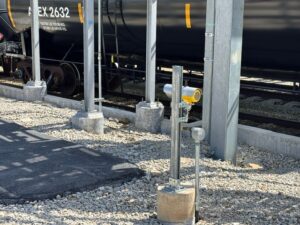
Aeropres has expanded its use of gas-detection technology across all its facilities, particularly in critical areas such as railcar loading and unloading.
These systems continuously monitor for potential gas leaks and alert plant personnel when a condition requires attention. At the Morris facility, the detection system is divided into multiple zones, allowing operators to quickly identify the general location of a potential leak. The system is also integrated directly with the plant’s automation and control systems.
If gas is detected, the system activates established alarm and response protocols. If the condition persists and remains unresolved within the designated response period, the system automatically shuts down plant operations. Restarting requires authorized personnel to verify that the source of the alarm has been identified and properly addressed.
“Many plants use gas-detection technology, but we have taken additional steps by zoning the system and integrating it with our plant automation,” said Tim Erway, Aeropres Director of Operations for the Morris, Manhattan, and New Jersey facilities. “The system is designed to provide operators with actionable information and an additional layer of protection.”
Planning, installation, automation integration, testing, and validation of the enhanced system represented approximately two years of coordinated work.
Adding Automated Safeguards to the Loading Process
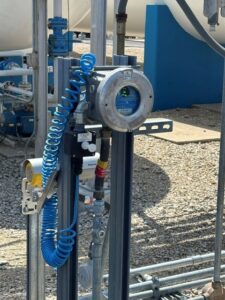
Aeropres has also installed positive grounding interlocks at loading stations to help control static-electricity risks during trailer loading.
Before loading begins, an operator connects a grounding clamp to the trailer. A visual indicator confirms whether a proper ground has been established. The loading process cannot begin without that confirmation.
The system continuously monitors the connection throughout loading. If the grounding connection is lost at any point, the interlock immediately stops the process.
Grounding cables have long been a standard part of Aeropres loading procedures. The newer system adds both confirmation and automated control, giving operators clear visual assurance that the connection has been made and maintained.
“This is part of a broader effort to expand the use of automation and control-system technology throughout our facilities,” said David Fox, Aeropres Director of Environmental Health and Safety. “These systems provide additional safeguards while also supporting greater consistency in our operations.”
Improving Walking and Working Surfaces
Some of the most meaningful safety improvements are also among the most practical.
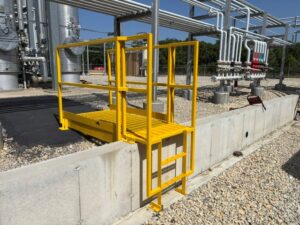
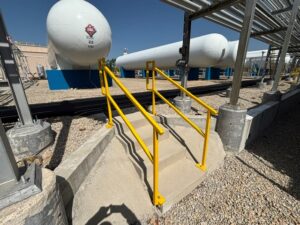
Aeropres recently added platforms and handrails in areas surrounding the rail racks at its Morris facility. These additions provide employees with safer access to below-grade work areas and help reduce the potential for slips, trips, and falls.
The improvements are particularly valuable during northern winters, when snow and ice can create additional challenges. While deicing materials and winter maintenance procedures remain important, properly positioned stairs and handrails provide employees with another critical layer of protection.
Aeropres has also installed designated paved walkways throughout the facility, making it easier and safer for employees to navigate the plant on foot.
These projects were identified through facility reviews and process hazard analyses. They reflect Aeropres’ continuing effort to improve walking and working surfaces while strengthening alignment with OSHA
requirements and corporate safety standards.
Creating One Visual Standard Across Every Facility
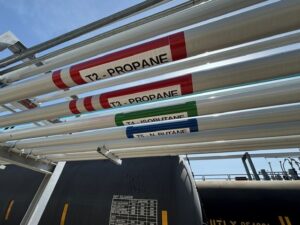
Consistency is essential to both safety and product quality, especially when employees may work at multiple Aeropres locations.
To support that consistency, Aeropres has established a companywide standard for identifying plant piping. Products are assigned specific colors that remain consistent across all facilities. For example, propane piping is red, isobutane is green, and normal butane is blue.
The standard is precise, extending to the approved paint specification for each color.
Piping is also clearly labeled at regular intervals, allowing employees to follow a line through the facility and quickly determine its product, destination, or associated tank. This makes maintenance work easier, helps prevent operational mistakes, and gives new employees a clearer way to learn the plant layout.
The value is especially apparent at the Morris and Manhattan facilities, where operators may occasionally move between locations. With the same visual standards in place, employees do not have to relearn product colors or identification systems when working at a different plant.
Standardization strengthens safety, supports training, and improves operational efficiency, all while helping Aeropres maintain consistent expectations throughout its network.
A Commitment That Continues
Safety improvement is never a one-time project. It is a continuous process of evaluating operations, identifying opportunities, and implementing practical solutions.
Some improvements involve sophisticated detection and automation systems. Others involve adding a handrail, improving a walkway, or making plant piping easier to identify. Together, they create safer, more consistent working environments.
At Aeropres, that commitment extends across every facility and every part of the operation. It is how we protect our people, strengthen our processes, and continue delivering the dependable service our customers expect.
Because making life better begins with making safety a priority, every day, at every location.